Q&A with RUMBO and Ashley Harder
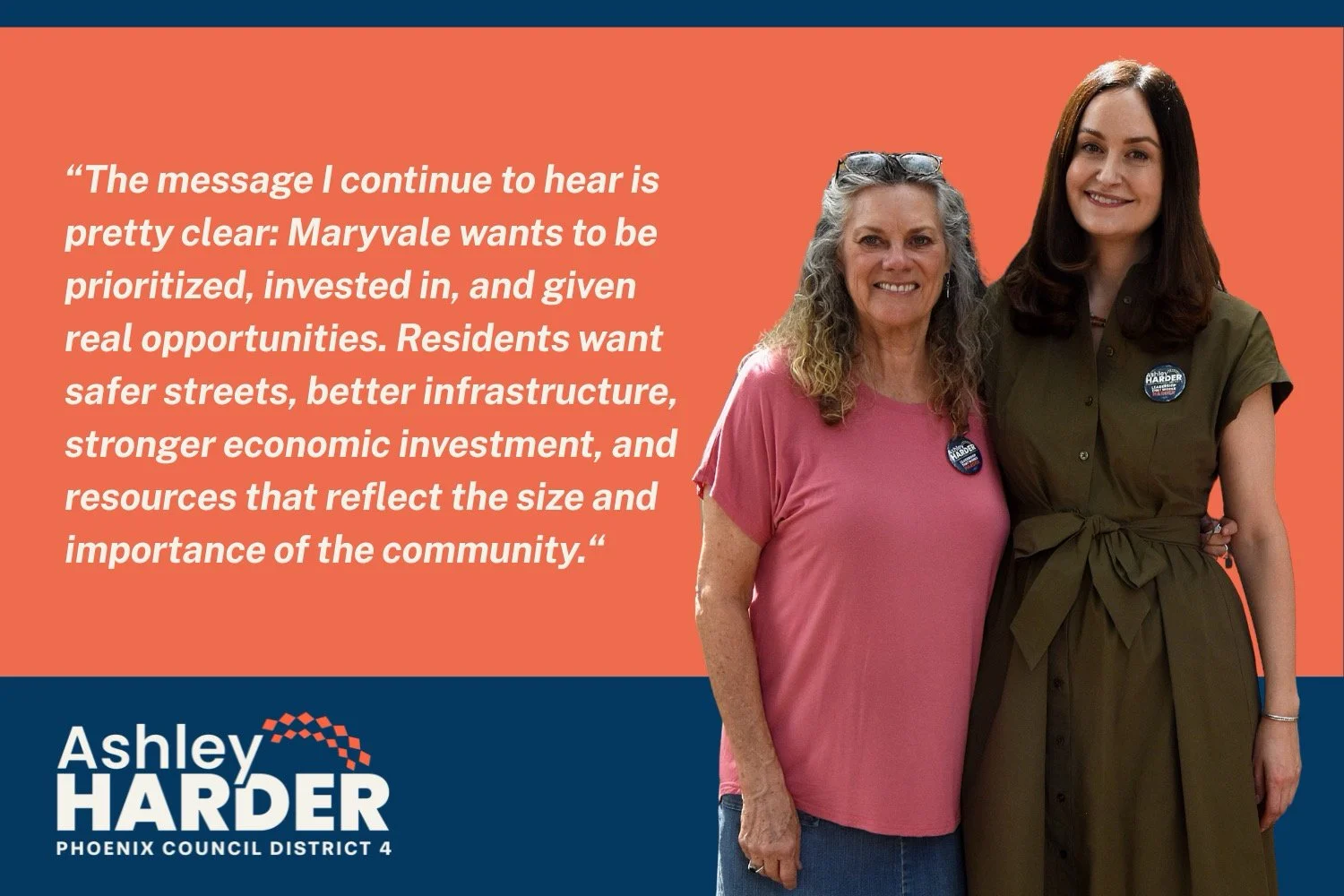
Jamie Cowgill and Ashley Harder
In parts of our city like West Phoenix, neighbors are feeling extreme heat more than others because their neighborhoods haven’t seen the same level of investment as other parts of Phoenix. There are fewer trees and shaded spaces, older infrastructure, hotter streets and sidewalks, and many families are under financial pressure when trying to afford to keep their homes cool and safe.
I really appreciate the climate justice advocacy that’s been building in West Phoenix and Maryvale, including from newer groups like RUMBO. The community has become more organized and vocal about the need for real investment, healthier neighborhoods, and long-term solutions.
I participated in RUMBO’s questionnaire to share my priorities for District 4 and how we approach these challenges as a city.
RUMBO: How have you engaged in environmental or climate-related work, either professionally or in your community?
When you work in Phoenix building spaces, you quickly learn that sustainability means responding to our climate realities, especially extreme heat.
I started Harder Development in 2009 to repurpose vacant, blighted, and sometimes historic properties to lease to small local businesses and entrepreneurs. To me, that has always been environmental and climate work in practice. At the time, I wasn’t seeing enough emphasis in Arizona’s building culture on limiting construction waste, reusing existing buildings, or diverting materials from our landfills.
Adaptive reuse is fundamentally about using what we already have to meet current community needs in a more sustainable way. Over time, I expanded that work to include sourcing recycled and salvaged materials, integrating energy efficient systems, and designing with heat mitigation and passive cooling strategies in mind.
I believe the future of resilient cities and neighborhoods will depend on our ability to thoughtfully conserve and adapt what we already have while further investing into healthier, more equitable communities for future generations.
RUMBO: Maryvale experiences some of the highest levels of extreme heat exposure in Phoenix. What specific policy priorities would you focus on to address this if elected?
My approach to extreme heat is to ask a few simple questions: what can we do immediately, what’s already working that we can scale up? Then, how do we create community-informed policies that actually address these unique challenges?
Immediately, we know cooling and heat respite centers work. We need more of them, more partnerships behind them, and directing residents and workers to where heat relief is available. Heat relief is still a relatively new public safety practice, and is only effective if people know it exists.
We also need to do a better job connecting residents to utility assistance programs that many families may not know about or realize they qualify for. Programs through APS, SRP, and LIHEAP can provide financial relief, but outreach and enrollment need to improve.
Long-term policy priorities should focus on community-led neighborhood reinvestment, shade and cooling infrastructure, weatherization programs for older homes, safer streets, and better connections to transit corridors. These investments make our neighborhoods safer and more comfortable during extreme heat, and that’s a big part of my Healthy Connected Neighborhoods priority.
Too often, through our urban planning efforts, we miss opportunities to create shade or provide tree canopy because we’re focused on compliance and detractions from our sustainability goals. As Phoenix continues to get hotter, every planning effort and development project should be looked at through the lens of heat resilience and long-term livability.
We’ll know we’ve succeeded when neighbors can comfortably and safely walk to transit, school, parks, and cooling centers in their community.
RUMBO: What role do you believe community members should play in shaping climate and environmental solutions in their neighborhoods?
What I continue to hear from residents and organizers in West Phoenix is that people want to see real action and investment they can actually feel in daily life. Residents know where shade is missing, where intersections feel unsafe, where bus stops are difficult to access in extreme heat, and what investments would make the biggest difference.
Community members should be at the center of conversations around climate and neighborhood investment, not brought in after decisions are already made. The people living with these challenges every day know their neighborhoods best.
A good example of this is the BRT line planned along 35th Avenue in District 4. During conversations with planners, it became clear there wasn’t enough integration with the city’s sustainability and equitable mobility goals.
If we’re investing in the surrounding neighborhoods that means cool corridors, shaded bus stops and safe walking routes that make it easier for neighbors to actually access transit during extreme heat.